
In Particle Board production, resin application is one of the most important steps between raw-material preparation and mat forming.
Wood particles need to receive the required amount of adhesive before they enter the forming section. But applying resin is not simply a matter of pumping glue into the blender.
The adhesive needs to be introduced into the particle stream in a controlled and repeatable manner.
Inside a Ring Glue Blender, the Spray Gun plays an important role in this process.
The Spray Gun is the component that delivers and disperses adhesive into the moving material stream. Its nozzle condition, spray pattern, sealing condition and compatibility with the resin system can all influence practical glue-application performance.
Although it is a relatively small component, it operates in a demanding environment and is therefore commonly treated as an important wear and maintenance part.
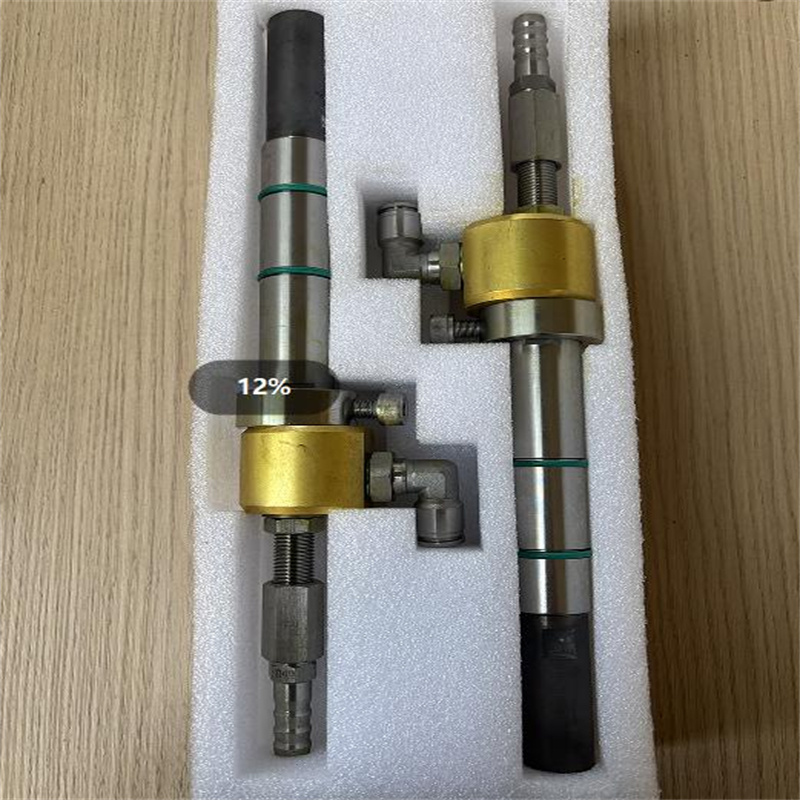
A Spray Gun used in a Ring Glue Blender is a specialized adhesive-application component designed to introduce resin into the moving wood-particle stream.
Depending on the equipment design, the gun may work with different pressure, atomization and nozzle arrangements.
Its main objective is to achieve controlled adhesive delivery.
A typical glue-blending process can be represented as:
Particle Feeding → Resin Delivery → Spray / Atomization → Mechanical Mixing → Discharge
The Spray Gun is located at the resin-delivery stage.
The Mixing Paddle then helps continue particle movement and redistribution inside the blender.
This makes the two components complementary:
Spray Gun = Introduces the adhesive
Mixing Paddle = Moves and mixes the particles
Understanding this difference is important when troubleshooting glue-blending problems.
One of the most important characteristics of a Spray Gun is the spray pattern.
The resin should reach the intended material zone rather than simply being discharged into the blender.
Depending on the nozzle and gun design, different spray characteristics may be required for different applications.
Factors can include:
The correct combination helps the adhesive reach a larger and more appropriate portion of the particle stream.
A common misunderstanding is that increasing resin flow will automatically improve adhesive coverage.
In reality, the effectiveness of glue application depends on both quantity and distribution.
For example, excessive local application may create wet spots while other particles receive insufficient coverage.
This is why a Spray Gun must deliver adhesive in a controlled pattern.
The goal is not simply:
More Resin
but:
More Controlled Resin Distribution
The actual resin dosage depends on the production recipe, particle condition, resin characteristics and process settings.
Because the two parts are installed inside the same Ring Glue Blender, they are sometimes discussed together.
However, their functions are different.
Responsible for controlled adhesive delivery.
Responsible for creating particle movement and mechanical mixing.
The overall process can be understood as:
Resin Application → Particle Movement → Surface Contact → Mixing → Blended Material
A Spray Gun with a stable spray pattern gives the Mixing Paddle a more predictable material condition to work with.
This is why both components need to be maintained.
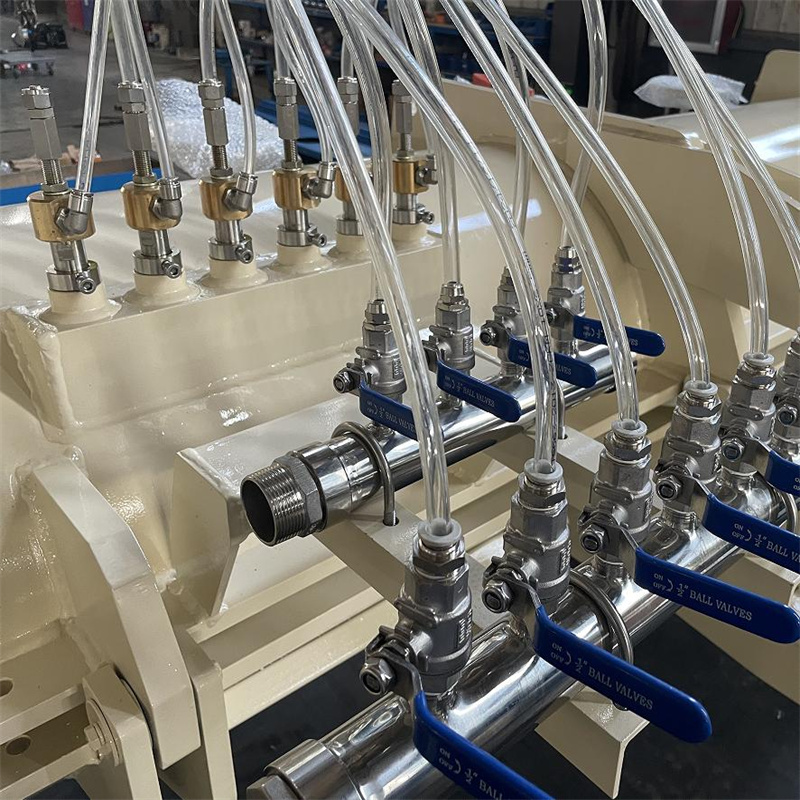
The Spray Gun operates in contact with resin, fine wood particles and dust.
Several conditions can gradually affect its performance:
As these conditions develop, the gun may no longer produce the same spray behavior as when it was new.
The key point is:
A Spray Gun can continue operating while its spray performance is already changing.
This makes preventive inspection particularly important.
The nozzle is one of the most important parts of the Spray Gun.
Small changes in the nozzle opening can influence the spray pattern and flow.
Possible causes include:
As the nozzle condition changes, the spray may become:
This can affect how adhesive reaches the particle stream.
For this reason, nozzle inspection should be part of routine Ring Glue Blender maintenance.
Resin systems can be sensitive to contamination, viscosity and drying.
If adhesive remains inside the Spray Gun or nozzle for too long, deposits may form.
Fine particles can also enter the spray system under unsuitable operating conditions.
A partially blocked nozzle can be particularly difficult to detect because the gun may still be spraying.
However, the spray pattern may already be abnormal.
Common warning signs include:
Early cleaning and inspection can prevent a small blockage from becoming a production issue.
The Spray Gun does not operate independently from the resin.
Adhesive properties can influence how the spray system behaves.
Important factors can include:
The same Spray Gun configuration may behave differently when resin conditions change.
Therefore, abnormal spray performance should not automatically be attributed to the gun itself.
The resin preparation and supply system should also be checked.
Another important factor is the relationship between pressure and material flow.
Too little pressure may result in poor atomization or insufficient spray coverage.
Excessive pressure may create undesirable spray behavior or increase component stress.
The correct operating range depends on:
For this reason, Spray Gun selection should be based on the actual Ring Glue Blender system rather than a generic pressure specification.
A worn Spray Gun does not necessarily stop working immediately.
More often, its performance gradually deteriorates.
Potential symptoms may include:
Some areas receive more adhesive than others.
The actual resin output may no longer remain stable.
Wear changes the intended spray characteristics.
Worn seals or connections may allow resin to escape.
Deposits accumulate more quickly.
Poor spray behavior can leave adhesive in unintended areas.
When these symptoms appear, the Spray Gun should be inspected together with the nozzle, seals, supply line and resin condition.
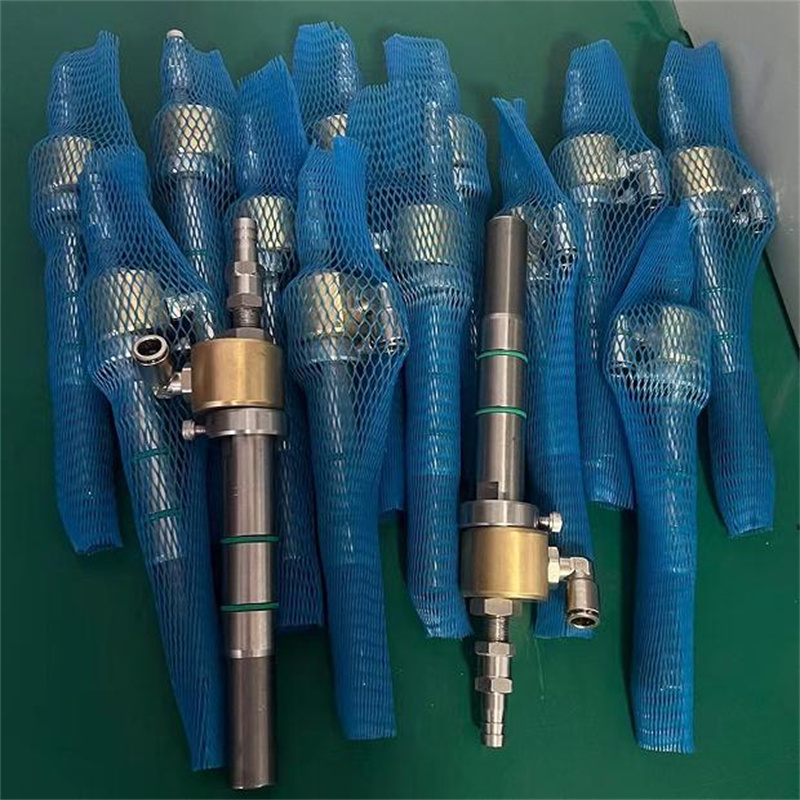
A Ring Glue Blender generally works through a combination of resin application and mechanical mixing.
The simplified process is:
Wood Particles
↓
Spray Gun
↓
Resin Application
↓
Mixing Paddle
↓
Particle Redistribution
↓
Glue-Blended Material
↓
Forming Section
The Spray Gun therefore influences the first stage of adhesive introduction.
The Mixing Paddle then continues the mechanical interaction between the particles.
This is why the Spray Gun deserves attention as a process component rather than simply a small replacement part.
A Spray Gun may appear to be working normally by visual inspection.
But visual spraying does not always tell the whole story.
A proper evaluation should consider:
The real objective is not to produce a visually attractive spray.
It is to create the spray condition required by the production process.
Ring Glue Blenders are not all built identically.
Different machine models may use different:
Therefore, the correct replacement should be based on the actual machine.
A Spray Gun that looks similar externally may still have different internal or nozzle specifications.
Because Spray Guns operate in contact with resin and abrasive contamination, material selection can affect service life.
Important parts may include:
The appropriate material depends on the resin characteristics and operating environment.
Wear resistance and chemical compatibility should both be considered.
Using the hardest material alone does not guarantee the best result.
A practical maintenance program should include regular inspection.
Look for deposits, wear or deformation.
Check whether the spray remains stable and properly distributed.
Look for leakage or deterioration.
Verify that fittings remain secure.
Remove appropriate deposits according to the machine's maintenance procedure.
Confirm that pressure, temperature and viscosity remain within the required process conditions.
A small change in position or angle can affect spray coverage.
Replacement should be considered when:
It is generally better to plan replacement before the component causes a major interruption in the glue-blending process.
Before ordering a replacement Spray Gun, confirm:
Different Ring Glue Blenders can use different gun configurations.
Inlet, outlet and mounting interfaces should be checked.
Nozzle size, type and spray characteristics need to match the application.
Adhesive properties influence the required gun configuration.
The gun should be compatible with the actual supply system.
The required resin delivery must match the production process.
The location and orientation need to correspond to the original machine.
An original Spray Gun, nozzle or technical drawing can greatly improve replacement accuracy.
For non-standard Ring Glue Blenders, a generic Spray Gun may not provide the required compatibility.
HUATAO can evaluate replacement requirements based on:
Customized supply can help match the original equipment more accurately.
HUATAO supplies Spray Guns for Ring Glue Blenders used in wood-based panel production.
Related Ring Glue Blender spare parts can include:
Applications include:
The products can be matched according to machine model, technical drawing, sample and operating requirements.
Compared with the complete Ring Glue Blender, a Spray Gun is a small component.
But it performs at the exact point where adhesive enters the process.
If the spray pattern changes, the condition of the particle stream can change.
If the nozzle becomes blocked, resin delivery can become unstable.
If the gun leaks, adhesive may be lost or deposited in unintended areas.
This means the condition of the Spray Gun can influence more than simply the appearance of the spray.
It can affect the consistency of the entire glue-application stage.
The overall relationship can be summarized as:
Resin Supply
↓
Spray Gun
↓
Controlled Adhesive Application
↓
Mixing Paddle
↓
Particle Redistribution
↓
Glue-Blended Material
↓
Mat Forming
The Spray Gun is only one part of the system, but it occupies an important position.
Maintaining its nozzle, seals, connections and spray performance can help keep adhesive application more predictable.
The Spray Gun is an important wear and maintenance component in Ring Glue Blenders used for wood-based panel production.
Its role is to introduce adhesive into the moving particle stream with the spray characteristics required by the process.
Its performance depends on several factors:
Nozzle Condition
Spray Pattern
Flow Stability
Pressure Compatibility
Resin Characteristics
Seal Condition
Mounting Accuracy
Overall Machine Compatibility
For Particle Board, MDF, HDF, OSB and FOSB production lines, a properly selected and maintained Spray Gun can help support consistent resin application and stable glue-blending performance.
The objective is not simply to replace a damaged spray gun.
It is to maintain the correct connection between resin supply, spray application and particle mixing throughout continuous production.
HUATAO Wood-Based Panel Machinery
Email: bella@huataogroup.com
Tel: +86 17731169773
Website: www.woodpanelmachinery.com
HUATAO provides Ring Glue Blender Spray Guns, Spray Nozzles, Glue-Blending Claws, Mixing Paddles and other glue-blender spare parts for Particle Board, MDF, HDF, OSB and FOSB production lines.
#SprayGun #RingGlueBlenderSprayGun #GlueBlenderSprayGun #GlueSprayGun #ResinSprayGun #SprayNozzle #GlueSprayNozzle #AdhesiveSprayGun #RingGlueBlender #GlueBlenderSpareParts #ParticleBoardGlueBlender #ParticleBoardMachinery #GlueApplication #ResinApplication #ParticleBoardProduction #MDF #HDF #OSB #WoodBasedPanel #HUATAO
can not be empty
can not be empty

HUATAO Wood-based Panel Machinery Co., Ltd
ADD : No.298 Zhonghua North Street, Shijiazhuang 050000 China.
TEL : +86 0311 80690567
EMAIL :bella@huataogroup.com
Web: www.woodpanelmachinery.com
 WhatsApp & WeChat : +86 17731169773