
For manufacturers operating MDF, HDF and particleboard production lines, industrial belt brushes are important cleaning components in compatible panel cleaning systems.
After extended operation, brush filaments may wear, deform or lose their original cleaning performance. When replacement becomes necessary, finding the correct dimensions is essential.
However, many maintenance teams do not have the original technical drawing.
In this guide, we explain the main dimensions required to identify and replace an industrial belt brush.
An industrial belt brush generally consists of two main sections:
Brush Filaments: The filaments are arranged along the working side and make contact with the cleaning surface.
Backing Belt: The base supports the filaments and provides the mounting structure.
Before taking measurements, identify these two sections to avoid confusing filament dimensions with the overall product dimensions.
Three details should be considered.
Filament Diameter - This refers to the diameter of an individual filament.
Filament Length - Measure from the surface of the backing belt to the filament tips.
Filament Material and Arrangement - If known, provide the filament material, density and arrangement.
These details help clarify the original brush construction.
The backing belt determines the mounting dimensions and supports the brush filaments.
Confirm:
The overall brush height should be measured separately from the filament length.
The total belt length is particularly important for replacement compatibility.
There are two common configurations:
Endless Belt Brush - Measure the complete loop circumference and clarify whether the measurement follows the inner surface, outer surface or centerline.
Open-Ended Belt Brush - Measure the overall developed length from one end to the other.
Do not estimate the total length from a photograph. If possible, use the original product or machine installation dimensions.
The working width determines the area covered by the brush.
It should be checked against the machine's cleaning width and installation arrangement.
If the brush has multiple sections, confirm whether the quoted width refers to one section or the complete assembly.
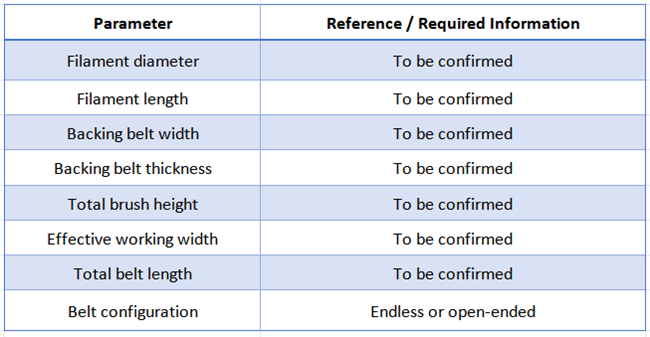
You can still provide useful information for a replacement evaluation.
We recommend preparing:
If the brush is still installed, photos showing its operating path can also help clarify the required belt configuration.
To help evaluate your requirements, please provide the available dimensions, machine information and product photographs.
If some measurements are unavailable, indicate which dimensions are uncertain rather than estimating them.
The technical details can then be reviewed before confirming the replacement specification.
Measuring an industrial belt brush requires more than checking its filament length.
Filament diameter, backing belt dimensions, overall brush height, working width and total belt length all contribute to replacement compatibility.
A clear measurement record helps reduce ordering errors and makes the replacement process more straightforward.
can not be empty
can not be empty

HUATAO Wood-based Panel Machinery Co., Ltd
ADD : No.298 Zhonghua North Street, Shijiazhuang 050000 China.
TEL : +86 0311 80690567
EMAIL :bella@huataogroup.com
Web: www.woodpanelmachinery.com
 WhatsApp & WeChat : +86 17731169773