
In the manufacturing of MDF, particleboard and other melamine-faced panels, impregnated decorative paper must be prepared according to the dimensions required for the finished boards.
The cutting process may appear straightforward, but paper feeding, positioning, cutting quality and material collection all influence the overall production workflow.
A suitable melamine paper cutting machine can help manufacturers improve cutting consistency and organize paper preparation more efficiently.
Melamine impregnated paper is widely used as a decorative surface material for wood-based panels.
Before lamination, the paper needs to be cut into the required dimensions.
A melamine paper cutting machine is used to process paper sheets according to the specified width and length.
Its configuration should be selected according to the paper specifications, panel dimensions and production requirements.
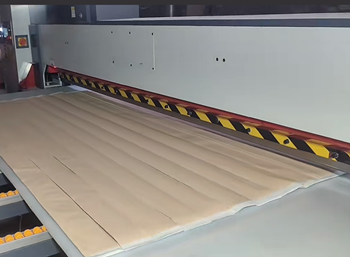
Cutting accuracy depends on several mechanical and operational factors.
The paper should enter the cutting area without unnecessary movement.
A suitable feeding arrangement helps reduce slipping and positioning deviations.
The positioning system determines where the paper is cut.
Consistent positioning helps maintain the required sheet dimensions, particularly when processing repeated batches.
The cutting blade influences edge quality.
A worn or damaged blade may contribute to rough edges, tearing or inconsistent cutting results.
Regular inspection and timely maintenance are important.
The machine's guiding, positioning and cutting mechanisms need to work together.
Mechanical looseness or misalignment may affect repeatability and finished dimensions.
Cutting efficiency is influenced by the complete working cycle rather than cutting speed alone.
A typical workflow includes:
Paper Feeding → Positioning → Cutting → Discharging → Stacking
When these operations are properly coordinated, unnecessary manual handling and repeated adjustments may be reduced.
Depending on the machine configuration, automatic feeding, programmed cutting dimensions and automatic discharging can help improve workflow organization.
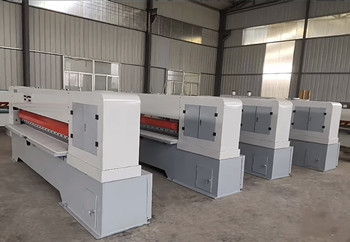
| Parameter | What to Consider | |
| Paper width | Maximum and minimum working width | |
| Paper length | Required cutting dimensions | |
| Paper thickness | Actual material specification | |
| Cutting accuracy | Required dimensional tolerance | |
| Feeding system | Manual or automatic | |
| Positioning system | Guiding and positioning method | |
| Cutting mechanism | Blade type and cutting arrangement | |
| Discharging | Manual or automatic collection | |
| Production capacity | Required output per shift | |
| Maintenance |
|
Selecting equipment based on actual production requirements is more reliable than focusing only on the machine's advertised cutting speed.
To maintain stable cutting performance, operators should regularly:
The maintenance schedule should follow the machine manufacturer's recommendations and actual operating conditions.
Before requesting a quotation, it is helpful to provide:
Photos or videos of the existing paper preparation process can also help clarify the requirements.
A melamine paper cutting machine should be evaluated according to both cutting accuracy and production workflow.
Stable feeding, accurate positioning, suitable cutting conditions and efficient material collection work together to support consistent paper preparation.
For manufacturers looking to improve their decorative paper processing, understanding these factors is a practical starting point.
The objective is not simply to cut faster, but to prepare paper more accurately and efficiently for the next production stage.
can not be empty
can not be empty

HUATAO Wood-based Panel Machinery Co., Ltd
ADD : No.298 Zhonghua North Street, Shijiazhuang 050000 China.
TEL : +86 0311 80690567
EMAIL :bella@huataogroup.com
Web: www.woodpanelmachinery.com
 WhatsApp & WeChat : +86 17731169773