
Industrial chain specification depends on four variables: function (bulk conveying, transmission, board handling, or press assembly), dimensions (pitch, roller, link, width), material and heat treatment, and exact equipment compatibility. Continuous press chains (P40, P22.50, P22.45) require original press documentation. P22.50 and P22.45 are separate specifications unless interchangeability is confirmed.
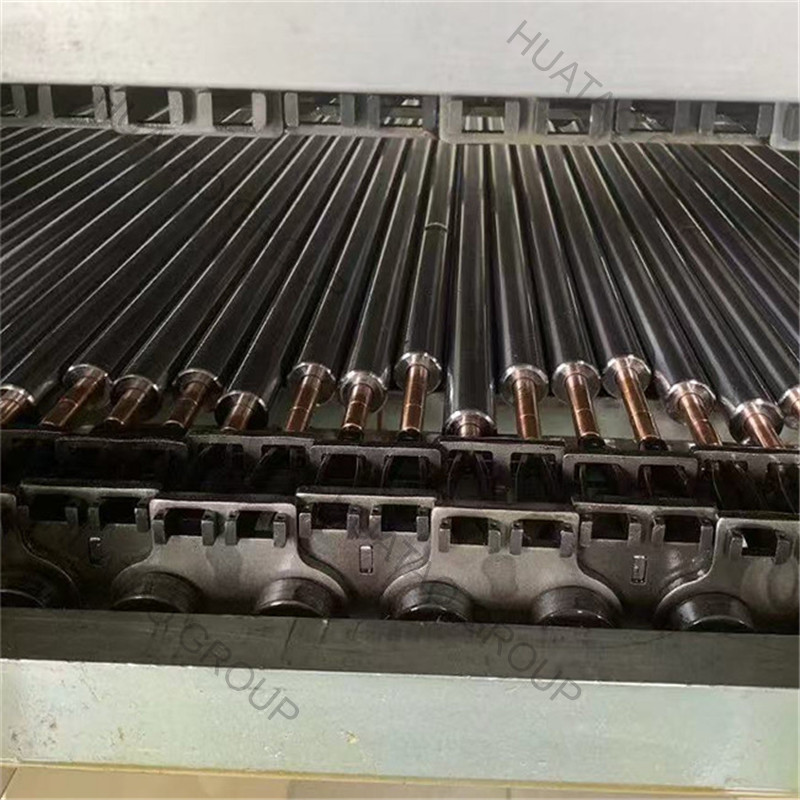
✓ Function determines chain type; nominal size alone is not a specification
✓ Continuous press chains are specialized assemblies, not conveying chains
✓ Pitch, roller dimensions, link dimensions, and attachments must match the original
✓ Material certificates and heat-treatment records are the only proof of grade
✓ Application: MDF, HDF, particleboard, OSB, and plywood lines across five production sections
| Verification Area | What to Confirm | Risk If Skipped |
|---|---|---|
| Chain type and function | Bulk conveying, transmission, handling, or press assembly | Wrong chain installed |
| Dimensions | Pitch, roller, link, overall width | Poor fitment, vibration |
| Material and heat treatment | Stated grade, treatment records | Premature wear, cracking |
| Load and conditions | Weight, speed, dust, temperature, lubrication | Shortened service life |
| Connection and attachments | Links, pins, locks, attachments | Installation failure |
| Equipment compatibility | Manufacturer, model, position, part number | Wrong specification ordered |
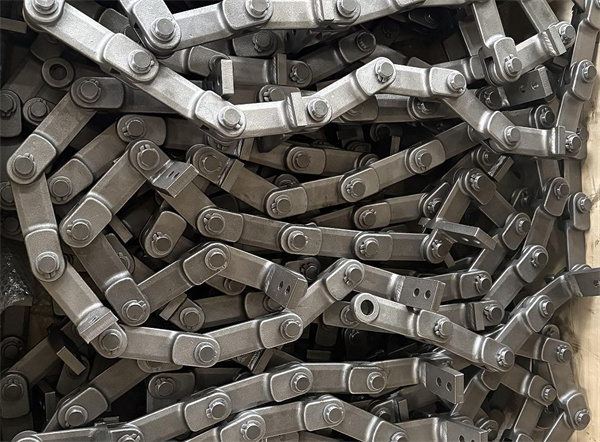
An industrial chain in a wood-based panel line is a mechanical component that transmits motion or transports material between process stages. Chains are specified by function: scraper conveyor chains push bulk residues, drag conveyor chains move material along a trough using flights, and continuous press chains form part of the press mechanism under demanding mechanical and thermal conditions. A chain that appears dimensionally similar may not be structurally suitable for a different function.
Chain conveying relies on a continuous loop driven by sprockets. Material is carried on the chain, pushed along a trough by scrapers or flights, or moved by attachments configured for a handling mechanism. In continuous press systems, the chain assembly forms part of the press itself, so pitch, link structure, connection details, and material properties must match the original design. Sprocket engagement depends on accurate pitch and roller dimensions; service life depends on material grade, heat treatment, lubrication, alignment, and operating conditions.
Process continuity: Correct chains support stable material flow between sections
Compatibility: Matching original specifications reduces installation problems
Predictable maintenance: Documented dimensions allow planned replacement
Wear management: Appropriate heat treatment extends service intervals
Downtime reduction: Correct identification avoids repeat replacement
In raw material preparation, scraper and drag chains handle chips, sawdust, bark, and residues. In screening, chain-driven mechanisms support equipment operation in dusty conditions. In forming and glue application, chains coordinate material delivery. In pressing, specialized assemblies serve continuous press systems. In board handling, chains transfer panels through cooling, cutting, sanding, sorting, stacking, and packaging.
Adjacent process context is useful for specification. The DRUM CHIPPER page covers initial size reduction, the WOOD CHIPS SCREEN page covers screening, and the IMPORTANCE OF WOOD CHIP SCREENING MACHINES IN MDF AND PARTICLE BOARD PRODUCTION guide explains how chip consistency affects conveying load. Forming equipment is documented on the FORMING MACHINE page and the MACHINE OF DENSITY EQUALIZER FOR PARTICLE BOARD FORMING guide.
| Material Approach | Wear Life | Cost | Maintenance | Best Application | Procurement Risk |
|---|---|---|---|---|---|
| Standard carbon steel | Low to moderate | Low | Frequent inspection | Light bulk conveying | High in abrasive service |
| Heat-treated alloy steel | High | Medium | Scheduled replacement | Scraper, drag, press chains | Low with certificates |
| Case-hardened chain | High surface hardness | Medium to high | Sprocket wear monitoring | Dusty service | Medium—verify case depth |
| Stainless or coated chain | Moderate | High | Corrosion inspection | Wet or resin-coated material | Medium—confirm coating spec |
| Chain Application | Load Type | Critical Dimension | Recommended Verification |
|---|---|---|---|
| Scraper conveyor chain | Bulk, continuous | Pitch, scraper attachment | Attachment drawing, strength data |
| Drag conveyor chain | Bulk, along trough | Flight spacing, link width | Layout drawing |
| Feeding and transfer chain | Machine-to-machine | Drive compatibility | Original part number |
| Screening drive chain | Repeated, dusty | Dimensional accuracy | Pitch and roller dimensions |
| Continuous press chain P40 | High mechanical and thermal | Structure and connection | Siempelkamp specification |
| Dieffenbacher P22.50 / P22.45 | High mechanical and thermal | Separate specifications | Original technical documentation |
| Storage cross chain conveyor | Panel stacks | Conveyor structure fit | Installation drawing |
| Board transfer chain | Repetitive handling | Attachment structure | Handling mechanism drawing |
| Board Type | Raw Material Preparation | Screening | Forming | Pressing | Board Handling |
|---|---|---|---|---|---|
| MDF / HDF | Scraper and drag chains | Chain-driven mechanisms | Feeding chains | Continuous press chain | Cross chain conveyor |
| Particleboard | Scraper, drag, feeding chains | Chain-driven mechanisms | Forming line chains | Continuous press chain | Transfer and stacking chains |
| OSB | Scraper and drag chains | Chain-driven mechanisms | Forming line chains | Continuous press chain | Cross chain conveyor |
| Plywood | Log handling chains | — | — | Multi-opening press (different assembly) | Board transfer chains |
 Selection Guide
Confirm chain type and application; check pitch, roller dimensions, link dimensions, and overall width against the original specification; verify material grade and heat treatment meet strength, toughness, and wear requirements; consider load, speed, environment, dust, temperature, and lubrication; match connecting links, pins, locks, and attachments; and reference manufacturer, model, installation position, and original part number. A supplier that documents its range in this detail—as on the CHIPPER SPARE PARTS page—is easier to evaluate. For screening-side components often confused with chain parts, the V ROLLER & V DISC FOR CHIPS SCREEN / DYNASCREEN guide and SUPER FLAKE SCREEN FOR PARTICLE BOARD PRODUCTION LINE page provide clarification.
| Required Information | Detail |
|---|---|
| Drawings needed | Chain layout, attachment drawing, connection details |
| OEM part numbers | Original chain part number and press model |
| Material selection | Stated grade and heat treatment |
| MOQ | Confirm whether price covers one chain or a set |
| Lead time | Request production capacity evidence |
| Packaging | Confirm protection for pins and attachments |
| Shipping method | Match to urgency and order size |
| Inspection standards | Pitch, roller dimensions, tensile test, hardness |
| Supplier evaluation checklist | Certificates, inspection records, export experience, technical support |
Buyer questions to ask directly:
Can the supplier manufacture according to drawings?
Can the supplier provide material reports?
Can the supplier support OEM replacement?
Does the supplier have export experience?
Can the supplier provide wear-life recommendations?
For customized orders, provide the manufacturer, model, original part number, technical drawings, dimensions, or physical samples. A supplier's overall capability can be assessed through its PROFESSIONAL WOOD-BASED PANEL MACHINERY SOLUTIONS PARTNER FROM CHINA profile.
| Problem | Possible Cause | Recommended Solution |
|---|---|---|
| Premature wear | Wrong material grade or heat treatment | Verify certificates; match original |
| Chain elongation | Insufficient tensile strength | Recalculate load; select higher grade |
| Cracking | Heat treatment imbalance; fatigue | Review heat-treatment records |
| Poor fitment | Incorrect pitch or link dimensions | Request dimensioned drawing |
| Excessive vibration or noise | Sprocket misalignment | Check alignment; replace sprocket |
| Attachment failure | Incorrect attachment design | Match original structure |
| Pin or lock failure | Generic hardware substituted | Use approved connecting links |
| Material buildup | Dust exposure; inadequate lubrication | Review lubrication and enclosure |
| Low efficiency | Chain-to-sprocket mismatch | Verify pitch and roller dimensions |
| Excessive downtime | No spare inventory | Set minimum stock levels |
| Material mismatch | Supplier substituted grade | Require certificates per batch |
| Installation failure | Wrong identification (P22.50 vs P22.45) | Confirm against original documentation |
Daily inspection: Chain tension, lubrication, visible damage
Weekly inspection: Pins, locks, and attachments
Monthly inspection: Elongation and sprocket wear
Wear pattern monitoring: Record link and roller wear
Replacement timing: Follow original wear limits
Spare parts inventory: Minimum stock of links and attachments
Downtime reduction: Schedule inspection during planned stoppages
Preventive maintenance: Track lubrication intervals and alignment checks
Customer Type: MDF producer with continuous press line and upstream scraper conveying
Board Type / Material: MDF, mixed chips with moderate bark content
Operating Conditions: Three-shift operation, dusty environment, thermal load at press
Problem: Scraper chain elongation occurred faster than expected. A replacement press chain ordered by similar designation did not match the original assembly, causing installation delay.
Solution: Introduced a chain identification procedure requiring original part number, installation position, and dimensioned drawing before ordering. Requested material certificates and heat-treatment records. Sourced connecting links and attachments to original specification.
Result: Scraper chain replacement intervals improved by approximately 30%. Press chain identification errors were eliminated, reducing unplanned downtime. Maintenance planning became more predictable through per-position wear tracking.
Q1: What is the difference between a scraper conveyor chain and a drag conveyor chain?
Answer: A scraper conveyor chain uses attached scrapers to push bulk material, often enclosed. A drag conveyor chain moves material along a trough using attached flights. Both handle wood residues, but attachment design and layout differ. Selection depends on equipment design, not nominal size.
Q2: Are continuous press chains the same as conveying chains?
Answer: No. Press chains are specialized assemblies under demanding mechanical and thermal conditions. Their structure and dimensions must correspond to the original press design. Treating them as conveying chains risks installation failure and equipment damage.
Q3: Can P22.50 and P22.45 be used interchangeably?
Answer: They should be treated as separate specifications unless original documentation confirms interchangeability. Similar designations do not guarantee identical structure. Confirm against press manufacturer documentation before ordering.
Q4: What information is needed before ordering?
Answer: Provide manufacturer, model, original part number, installation position, technical drawings, dimensions, or physical samples, plus material and heat-treatment requirements. This reduces the risk of misfit.
Q5: How is chain material quality verified?
Answer: Request material certificates and heat-treatment records. Confirm the grade meets strength, toughness, and wear requirements. For press chains, request inspection records covering pitch, roller dimensions, and tensile properties.
Q6: How long do industrial chains last?
Answer: Service life depends on design, material, heat treatment, lubrication, alignment, and operating conditions. Dust and load variation accelerate wear. Track elongation per position for realistic intervals.
Q7: How should chains be maintained?
Answer: Inspect tension, lubrication, and damage daily; check pins and attachments weekly; measure elongation monthly. Record wear patterns and maintain minimum spare stock. Schedule inspection during planned stoppages.
Q8: How do I choose a chain supplier?
Answer: Compare documented specifications, inspection records, lead time evidence, and technical support. Ask about drawing-based manufacturing, material reports, and OEM support. Review NEWS & TECHNICAL ARTICLES and product documentation to assess depth.
Chain specification in panel lines depends on function, dimensions, material, and equipment compatibility. The most common errors are functional misidentification and specification confusion between similar designations. Both are avoidable with a disciplined identification procedure. For downstream context, the INDUSTRIAL SANDING MACHINE page and CONTINUOUS PRESS MACHINE page complete the process picture.
Related Products
Related Technical Guides
Related Buyer Guides
Email: bella@huataogroup.com
Mobile: +86 17731169773(WhatsApp / WeChat)
Website: www.woodpanelmachinery.com
#IndustrialChains #WoodBasedPanel #ScraperConveyor #DragChain #ContinuousPress #Siempelkamp #Dieffenbacher #MDF #ParticleBoard #OSB #SpareParts #WearParts #ConveyorSystem #Procurement #SupplierSelection #Maintenance #Engineering #Manufacturing #SupplyChain #IndustrialParts
can not be empty
can not be empty

HUATAO Wood-based Panel Machinery Co., Ltd
ADD : No.298 Zhonghua North Street, Shijiazhuang 050000 China.
TEL : +86 0311 80690567
EMAIL :bella@huataogroup.com
Web: www.woodpanelmachinery.com
 WhatsApp & WeChat : +86 17731169773