In wood-based panel manufacturing, the mat formed from wood fibers or particles contains air within its loose structure. Before the material enters the continuous hot press, the pre-press section gradually compresses the mat.
During this process, the displaced air needs to escape in a controlled way.
A deaeration belt is designed to support this process by providing an air-permeable surface while the mat moves through the relevant production section.
A deaeration belt is mainly associated with the mat handling and pre-pressing process in wood-based panel production.
Typical applications include:
MDF production lines
HDF production lines
Particleboard manufacturing
Selected OSB and other wood-based panel applications
Its exact position and configuration depend on the production line design. It may be integrated with a ventilation or pre-press belt arrangement to support air release during mat compression.
For an overview of Airing Belt applications, see the related product information.
After forming, wood fibers or particles are distributed into a loose mat. Air remains between the individual fibers or particles.
As the mat enters the pre-press section:
The mat is conveyed toward the pre-pressing area.
Mechanical pressure gradually reduces the mat thickness.
Air inside the mat moves toward the available escape paths.
The air-permeable belt structure supports air passage.
The mat continues toward the next production stage.
The purpose is to support controlled air release during pre-compression. The final result also depends on mat properties, machine pressure, line speed and the complete pre-press configuration.
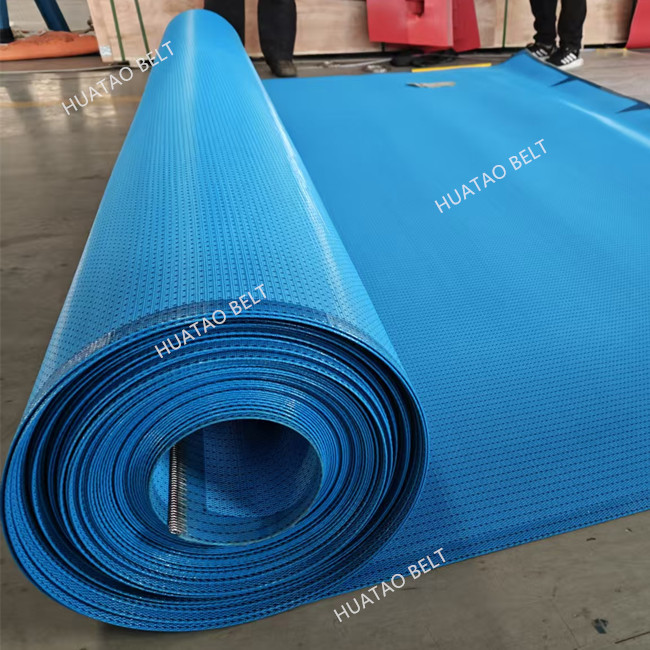
Air permeability is a key specification because the belt needs to allow air to pass through its structure.
However, the required permeability should be matched to the actual mat characteristics and operating conditions. A higher value alone does not guarantee better process performance.
The belt operates under continuous tension and repeated bending. Adequate tensile performance is important for maintaining stable operation.
Friction, fiber abrasion and continuous running can gradually affect the belt surface and structure. Wear resistance is therefore an important consideration when selecting a belt.
Wood fibers and dust may generate static electricity during production. Conductive yarns or other suitable antistatic structures can help dissipate accumulated charge and reduce static-related material adhesion.
The appropriate construction should be selected according to the plant's operating and safety requirements.
A belt needs to maintain suitable dimensions and tracking behavior during continuous operation. Belt tension, alignment, pulley condition and joint uniformity all influence running stability.
Different production lines may require different belt constructions.
Possible options include:
Carbon-fiber conductive construction: Conductive yarns can be incorporated into the belt structure to provide antistatic properties.
See Deaeration Belt with Carbon Fiber.
Copper-wire reinforced construction: Copper wire can be incorporated into the belt design to provide a different conductive reinforcement structure.
See Deaeration Belt with Copper Wire.
Other mesh and yarn constructions: Material selection, weave structure, thickness and permeability can be evaluated according to the equipment and process requirements.
No single construction is suitable for every production line.
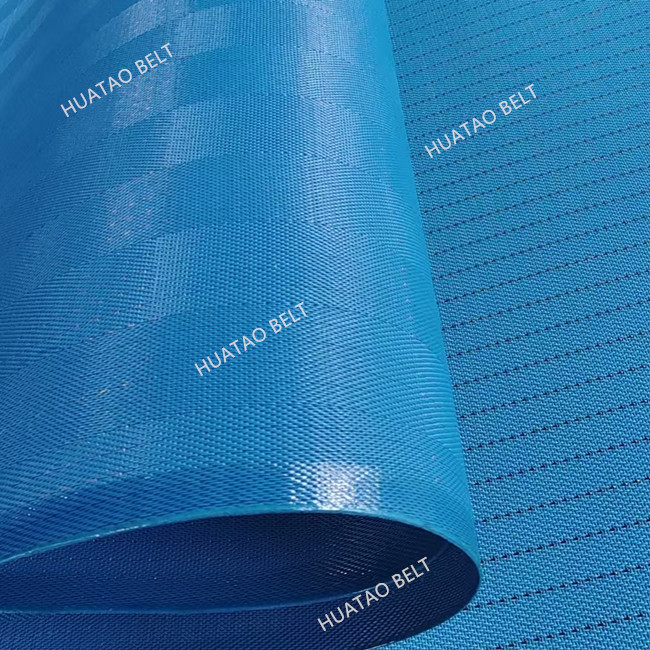
One common maintenance concern is the accumulation of fine fibers, dust and resin-related deposits.
When deposits accumulate inside the openings, the effective open area may decrease. This can affect airflow and increase cleaning requirements.
Possible contributing factors include:
Fine fiber and dust accumulation
Resin characteristics and deposits
Belt surface condition
Cleaning frequency and method
Operating temperature and humidity
Actual material and process conditions
To reduce blockage risks, the belt structure should be selected for the specific process. Regular inspection and suitable cleaning procedures are also important.
The joint connects the belt into a continuous loop and transfers operating tension.
An unsuitable joint may create problems such as:
Excessive thickness difference
Uneven running
Local wear
Difficulty during installation
Repetitive marks under certain machine conditions
Possible joint designs include Z-splice, mechanical pin or loop-type connections and other configurations, depending on the belt construction and machine requirements.
The correct joint should be selected according to pulley diameter, installation conditions, belt tension and the original equipment design.
Before requesting a quotation, please prepare the following information:
| Required information | Purpose | ||
| Machine manufacturer and model | Identify equipment configuration | ||
| Belt width and length | Confirm dimensions | ||
| Belt thickness | Check installation compatibility | ||
| Air permeability requirement | Match process needs | ||
| Belt material and construction | Confirm operating suitability | ||
| Antistatic requirement | Match the production environment | ||
| Joint type | Confirm installation and running conditions | ||
|
Help identify the original design |
If you are also replacing a Pre-Press Belt, confirm its dimensions, surface construction and joint requirements separately. A deaeration belt and a pre-press belt perform related but different functions.
For other belt products, explore Forming Belts and the HUATAO Belts product range.
You can also visit wood-based panel machinery and spare parts for more equipment-related products.
Choosing a deaeration belt is not only about matching width and length.
Air permeability, mechanical strength, wear resistance, antistatic properties, joint design and running stability all need to be considered together.
Whether you need a replacement belt or want to evaluate a different belt construction, providing the actual machine and operating information is the best starting point.
Contact us with your belt dimensions, machine model, existing belt photos and application details to discuss a suitable deaeration belt solution.
can not be empty
can not be empty

HUATAO Wood-based Panel Machinery Co., Ltd
ADD : No.298 Zhonghua North Street, Shijiazhuang 050000 China.
TEL : +86 0311 80690567
EMAIL :bella@huataogroup.com
Web: www.woodpanelmachinery.com
 WhatsApp & WeChat : +86 17731169773