
Particle Super Screens are used in wood-based panel production to classify flakes according to their size and distribution requirements. They help separate oversized, acceptable, and fine particles before the material moves to the next production stage.
The screen panel is one of the key components of this equipment. Its opening pattern, structural design, connection method, and maintenance accessibility all contribute to reliable operation.
When selecting replacement screen panels, manufacturers should consider more than dimensions and hole patterns. The connection method and repair strategy can also affect long-term maintenance costs.
Particle Super Screen panels are perforated screening components installed inside a screening machine. During operation, the screen separates wood flakes according to the size of the openings and the movement of the screening system.
The main factors affecting screen panel performance include:
Opening size and distribution
Open area and screening pattern
Panel dimensions and structural rigidity
Material selection and wear resistance
Connection design
Resistance to operating vibration
Ease of inspection and maintenance
A suitable screen panel should match the machine configuration and the characteristics of the material being screened.
The connection method is an important design consideration, especially when individual sieve elements may need to be repaired or replaced.
Riveting mechanically fastens components together using rivets.
Advantages:
Individual components may be removed and replaced without cutting and rewelding the assembly.
No welding heat is introduced during the joining process.
The risk of heat-related distortion during assembly is reduced.
Mechanical replacement may be more convenient for on-site maintenance.
The design can support modular repair when individual elements are replaceable.
Limitations:
Rivet holes require accurate positioning and machining.
Joint strength depends on rivet material, diameter, spacing, and structural design.
Repeated vibration may cause loosening or fatigue if the connection is not properly engineered.
Replacement still requires suitable tools and access to the joint.
Rivet heads and joint details must be considered in the overall screen design.
A riveted structure is particularly worth evaluating when the customer's maintenance strategy prioritizes replacing individual sieve elements.
Welding joins components through a metallurgical bond and is commonly used to manufacture integrated screening structures.
Advantages:
Can provide strong and rigid connections.
Supports integrated structural construction.
Suitable for repeatable manufacturing processes.
Eliminates the need for mechanical fasteners at welded joints.
Limitations:
Localized heat input may cause distortion or residual stress.
Repairing damaged sections may require cutting, grinding, and rewelding.
On-site repairs require appropriate equipment and qualified personnel.
Repeated repair welding may affect the local material and surface condition.
With appropriate welding procedures, fixtures, and quality control, welded structures can achieve reliable dimensional and structural performance.
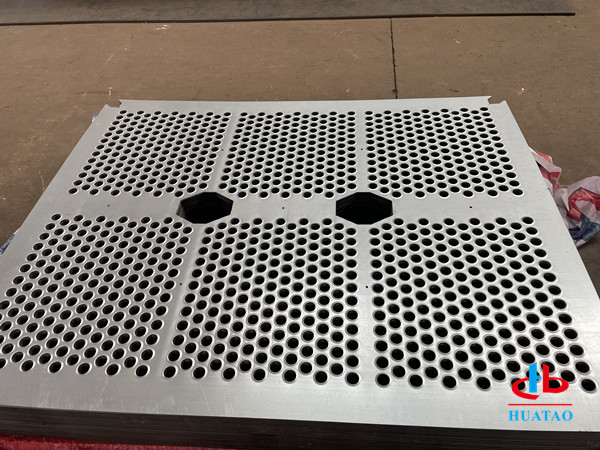
Neither method is automatically superior. The right solution depends on the screen design and the customer's operating and maintenance requirements.
| Factor | Riveted design | Welded design |
|---|---|---|
| Joining method | Mechanical fastening | Metallurgical joining |
| Heat input | No welding heat | Localized heat input |
| Structural rigidity | Depends on joint configuration | Can provide an integrated rigid structure |
| Component replacement | Can be easier in modular designs | May require cutting and rewelding |
| Manufacturing requirements | Accurate hole positioning and riveting | Welding procedures and distortion control |
| Maintenance considerations | Rivet inspection and replacement | Weld inspection and repair |
For a customer who specifically requires repairs without welding, a riveted connection may be a suitable design direction.
For applications where an integrated and rigid structure is the priority, a welded design may be appropriate.
The final decision should be based on load conditions, vibration, panel geometry, material thickness, and the expected repair method.
Connection design is not the only factor that determines how easy a screen panel is to maintain.
Elastic rubber balls are commonly used in certain screening systems to help prevent material from blocking the screen openings. During operation, the balls move beneath or within the screening assembly and repeatedly contact the screen surface.
Over time, rubber balls may wear, deform, or require replacement.
To make this maintenance task more convenient, our screen frame design includes dedicated access ports for rubber ball replacement.
Key benefits of this design include:
Direct access to the rubber ball replacement position
More convenient inspection and replacement
Reduced need for extensive screen disassembly, depending on the machine arrangement
Improved accessibility for routine maintenance
This feature is separate from the connection method of the sieve elements. Riveting or welding determines how the screen components are joined, while the access port is designed specifically to facilitate rubber ball replacement.
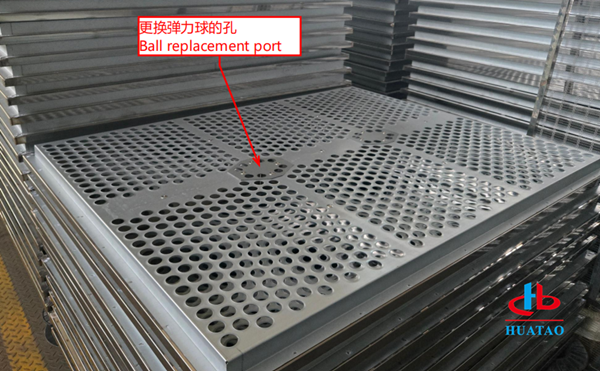
A well-designed superfine flake screen panel needs to meet two requirements: reliable performance during operation and practical maintenance throughout its service life.
Riveted connections can offer advantages in modular repair, while welded connections can provide an integrated and rigid structure. Neither should be selected without considering the actual operating conditions.
At the same time, details such as dedicated rubber ball replacement ports can make routine maintenance more convenient.
Looking for replacement screen panels for your particle super screen?
Share your machine model, panel dimensions, opening specifications, and connection requirements. These details will help determine a suitable screen panel configuration.
HUATAO Group – Screening components and spare parts for wood-based panel production lines.
can not be empty
can not be empty

HUATAO Wood-based Panel Machinery Co., Ltd
ADD : No.298 Zhonghua North Street, Shijiazhuang 050000 China.
TEL : +86 0311 80690567
EMAIL :bella@huataogroup.com
Web: www.woodpanelmachinery.com
 WhatsApp & WeChat : +86 17731169773